Leading beyond discomfort: how mind‑body awareness strengthens modern leadership
As leaders navigate increasing complexity, shifting expectations and diverse teams, many are finding that technical capability alone is no longer enough. Effective leadership now depends on the ability to recognise discomfort early, stay grounded under pressure and create environments where people feel safe to contribute.
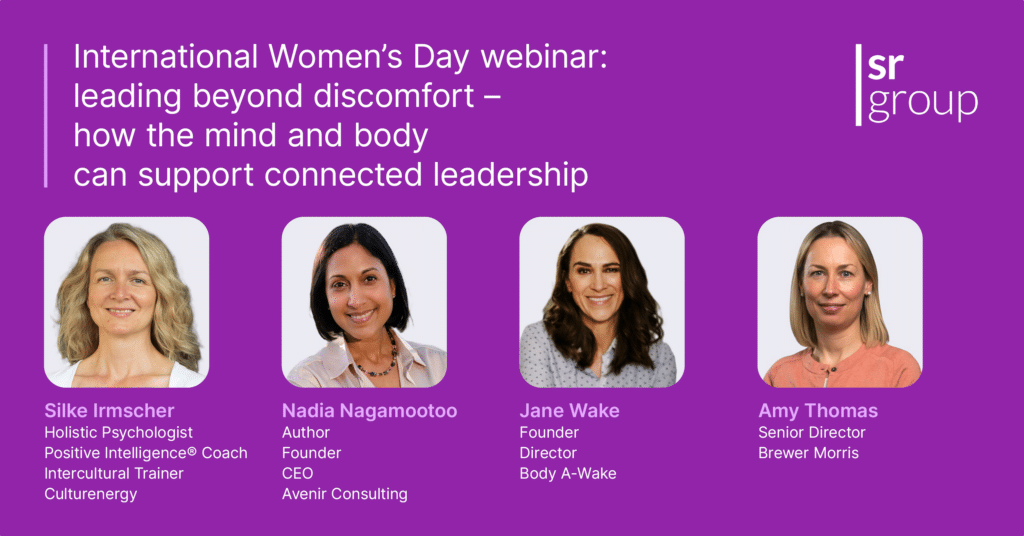
During our recent International Women’s Day webinar that we hosted as part of The SR Group, Silke Irmscher, Nadia Nagamootoo, Jane Wake and Amy Thomas explored how mind‑body awareness, emotional insight and inclusive behaviours can help leaders lead with greater clarity and impact. This article brings together the key themes and practical actions leaders can use to strengthen their presence and decision making in moments that matter.
Discomfort as a catalyst for leadership
In modern organisations, leaders face frequent moments of uncertainty – from difficult conversations to competing expectations. The webinar highlighted that discomfort is not a performance gap but a prompt to pay attention. When leaders notice hesitation early and stay engaged rather than stepping back, it opens the door to clearer thinking and more productive dialogue.
Turning emotional reactions into practical insight
Emotional responses often surface before the full picture is clear. Instead of overriding them, leaders can use these reactions to slow down and gather missing context. Acknowledging what you feel creates the space to ask better questions, understand others’ perspectives and avoid reactive decisions. This approach strengthens judgement and improves outcome quality.
Staying grounded through the mind-body connection
Physical cues usually reveal stress before the mind registers it. Tight shoulders, faster breathing or a rising heart rate signal that the nervous system is preparing for threat. Introducing short grounding practices – slowing the breath, lowering the shoulders, or adjusting posture – helps reset the system and restore focus. Leaders who use these micro‑resets enter conversations steadier and more composed.
Creating psychological safety through consistent behaviour
Psychological safety is built through what leaders repeatedly do: how they listen, how they respond and how they allocate airtime. Small habits such as pausing before replying, inviting quieter colleagues in, or maintaining neutral body language make a noticeable difference. When people know they can speak without immediate judgement, contributions improve and solutions strengthen.
Inclusion as a driver of organisational performance
The session underscored that inclusion is directly linked to business performance. When people feel valued and understood, commitment rises and attrition reduces. Leaders who recognise different lived experiences and adapt their approach accordingly create environments where individuals do their best work. Inclusion is not an add‑on; it is a core performance lever.
Using movement to support clarity and reduce stress
Movement is an underused but effective tool for regulating pressure. Many leaders experience physical tension well before mental overwhelm. Simple actions such as tapping, stretching or walking during conversations help release tension and sharpen cognitive focus. Normalising movement signals that wellbeing is part of how the organisation works, not an afterthought.
Leading inclusively across cultures
For leaders operating across global or diverse teams, awareness of cultural norms is essential. Communication styles, expressions of emotion and even grounding techniques can be interpreted differently. Adjusting tone, pace and presence helps build trust and prevents misunderstandings. This awareness strengthens relationships and supports more inclusive decision making.
leading with intention in uncertain moments
The key message is clear: discomfort is not something to avoid but something to work with. Leaders who stay attentive to their emotional and physical cues make better decisions, create safer environments and navigate challenges with greater clarity. By combining curiosity, grounded presence and inclusive behaviour, leaders build teams that are more connected, more confident and better equipped to perform.